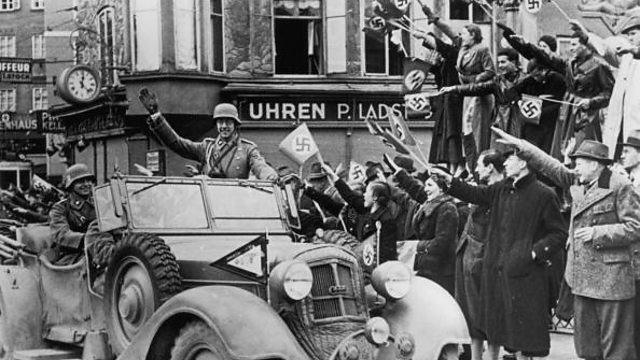
In March 1938, Adolf Hitler began his expansionist program of uniting “Greater Germany” by invading, occupying, and ultimately annexing Austria to the Third Reich. Explicitly […]
Europe, 1918-1939
In March 1938, Adolf Hitler began his expansionist program of uniting “Greater Germany” by invading, occupying, and ultimately annexing Austria to the Third Reich. Explicitly […]
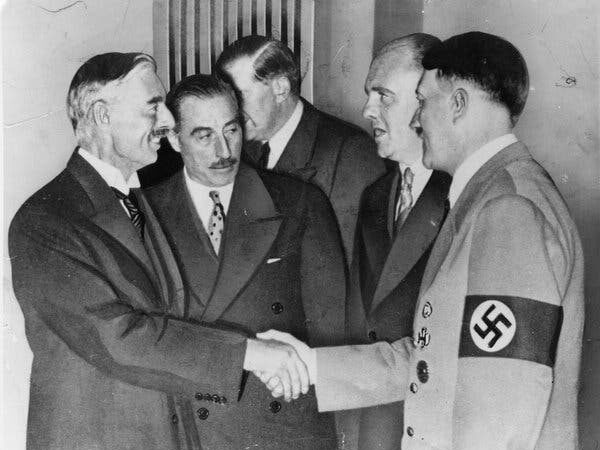
In September 1938, one year before the beginning of World War II, the British prime minister, Neville Chamberlain, flew to Germany to negociate a peaceful […]

Woodie Guthrie was an influential American folk singer, communist, and outspoken anti-fascist during between the 1940s and 1960s. In 1944, the year before the end […]

During the Second World War, as the Allies were making their way northwards up the Italian peninsula, the Italian partisan resistance began carrying out guerilla-style […]

Produced by the U.S. War Department in 1943, and re-released in 1947, Don’t Be a Sucker was intended to admonish Americans that “they will lose […]
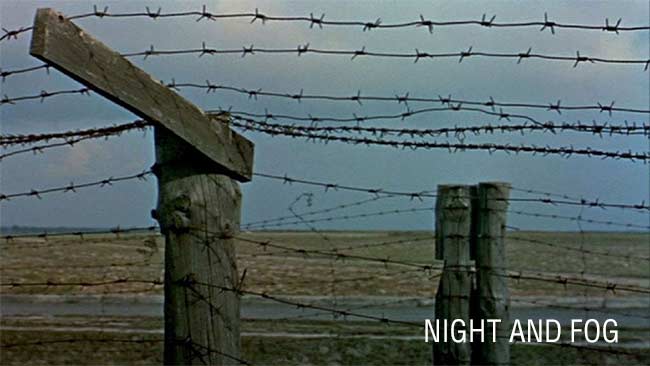
Directed by Alain Resnais, Night and Fog (Nuit et brouillard) is a 1956 French documentary on Nazi Germany’s concentration, labor, and extermination camps during the […]

In June 1945, the representatives from 46 nations gathered in San Francisco to debate and, ultimately, vote on the United Nations Charter, which marked the […]