
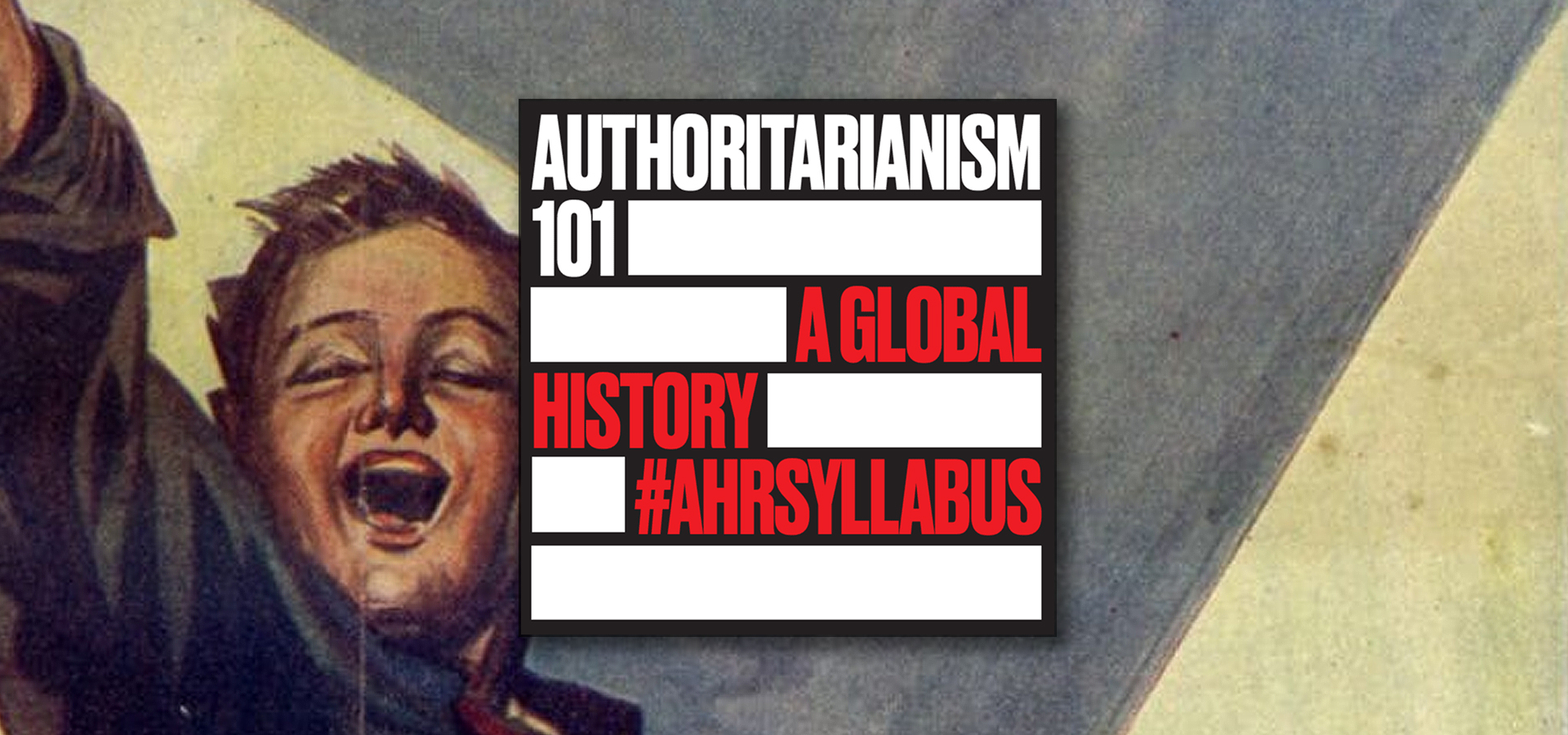
Teaching Module: “Authoritarian Aesthetics and Youth Appeals”
I along with my co-editor Dr. Amy King am pleased to announce the publication of our jointly-authored teaching module, "Authoritarian Aesthetics and Youth Appeals," in the American Historical Review's "Authoritarianism 101" series.
Below is an abstract for "Authoritarian Aesthetics and Youth Appeals," along with a link to a PDF copy of the essay.
Series Abstract

Authoritarianism 101: A Global History is a set of 30 primary source-driven teaching modules designed to offer teachers and students a broad perspective on the history of authoritarianism. The AHR commissioned historians working on authoritarian histories in Africa, Asia, Europe, Latin America, the Middle East, and North America to write teaching modules that explored a singular instance of an authoritarian past. Temporally, they range from the seventeenth to the early twenty-first centuries, with the bulk of modules concentrating on the long twentieth century.
Each module fuses scholarly content and teaching, nesting the source in a core question, a brief context essay based on the latest scholarship, and a teaching plan that suggests varied ways to dissect the primary source. We hope that high school social studies teachers see in the modules a way to study authoritarianism through the inquiry arc, and that college professors recognize the kinds of core questions that animate the research and teaching in their fields. The query-driven design of the modules reminds us that, at its best, history is a discipline driven by good questions, the kind that lead us to compelling human stories and dilemmas worthy of deep reflection and ongoing debate.
Everything you need to teach these modules successfully in your classroom is readily at hand, including video and podcast interviews with many of the project contributors who talk about how and why they created their modules and offer some additional teaching tips. Along with the classroom, we imagine these modules could be used for student-led discussions in high school or college about the histories of authoritarianism, or even in reading groups at local public libraries. The project’s Authoritarianism 101 Reading List offers an even deeper dive into the global histories of authoritarianism. This project is part of the American Historical Review’s #AHRSylllabus.
Module Abstract

This module offers a chance to explore how authoritarian regimes tried to appeal to young people, specifically, with the aim of portraying obedience to the state not as submission but as progress.
The setting is Italy in 1931, but Benito Mussolini’s two-decade dictatorship is the larger political backdrop. The source is a 1931 cover illustration of a fascist youth magazine, a publication dedicated to promoting a new kind of youthful warrior for a reinvigorated fascist Italy. Professors Brian Griffith and Amy King present this evocative image to ask students to consider why and how authoritarian regimes appealed to youth as a way to ensure the continuation of their rule. The teaching plan offers useful approaches to analyzing the colors, symbols, and facial and physical expressions in the source, enhancing students’ visual literacy skills. It even poses questions about the relationship between Italy’s high illiteracy rates and the authoritarian regime’s choice to communicate their messages to youth through visual materials, such as this one. As part of Authoritarianism 101, this module enables teachers to explore the theme of authoritarian practice by examining some of the tools of authoritarian control.
Download
To download a PDF version of this teaching module, click on the button provided below.